
-
 Order
Order -
 Search
 -
 International
 -
 Information
 -
 About Us
 -
 Login/Register
 OrderSearchInternationalInformationAbout Us
Login/Register
OrderSearchInternationalInformationAbout Us
Login/Register 



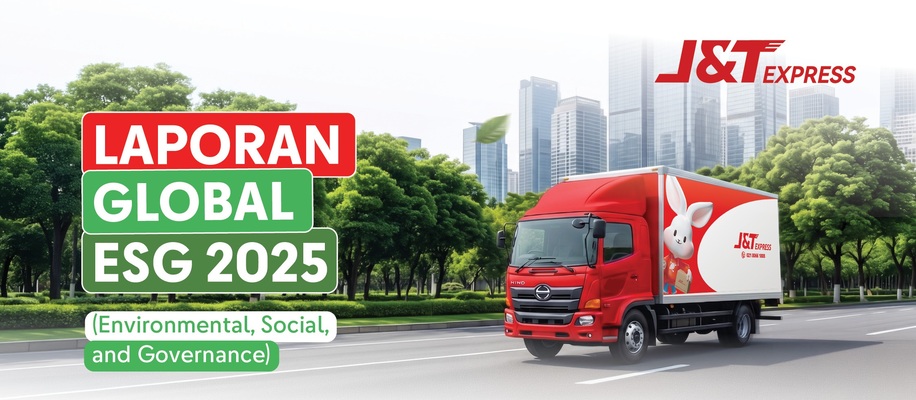
J&T Express, a global logistics service provider, today released its 2025 Environmental, Social, and Governance (ESG) Report globally. The report comprehensively outlines the Company’s latest practices and achievements in smart operations, energy management, employee rights protection, talent development, business ethics, and social responsibility. It also highlights J&T Express’ commitment to integrating sustainability initiatives across its global logistics network while driving high-quality growth.
Over the past year, J&T Express has implemented smart logistics and energy transformation by leveraging Artificial Intelligence (AI) and big data throughout its operational chain. These initiatives have positively contributed to route optimization, improved sorting efficiency, and strengthened last-mile delivery services. J&T Express also expanded its global network through the development of 14 core logistics parks worldwide, covering a total gross floor area of 1.05 million square meters, while strengthening infrastructure with more than 150,000 permanent magnet synchronous motorized rollers and over 400 energy-saving conveyor belts. Meanwhile, the Company continued to expand its green packaging initiatives through the deployment of 38.27 million reusable transit bags, which have been utilized approximately 3.33 billion times.
In terms of low-carbon transportation, J&T Express continues to promote cleaner and electrified vehicles. In China, the number of LNG trucks reached 1,697 units, accounting for 30% of the total fleet, while the Philippines has fully adopted B5 biodiesel and Singapore operates 6% electric trucks within its fleet. By the end of 2025, J&T Express had also deployed more than 1,000 autonomous vehicles. In addition, the Company continues to strengthen the utilization of railway and maritime transportation to improve operational efficiency.
J&T Express continues to strengthen its commitment to creating an inclusive and equal-opportunity workplace, supported by employee care systems focused on career development, health, and well-being. In China, the implementation of the Platform Algorithm and Labor Rules Agreement 2025 marked an important milestone. Covering more than 290,000 workers, the agreement focuses on wage protection, career development, and algorithm transparency, while strengthening worker protection in the digital economy era.
In terms of talent development, J&T Express consistently strengthens its integrated global training system. Throughout 2025, the number of courses on its digital training platform increased by 60%, while total training hours grew by 2.8 times. In addition, more than 27,000 safety training sessions were conducted globally, reaching over 1.4 million participants and reinforcing the Company’s safety culture and employee protection foundation sustainably.
J&T Express consistently reinforces its social commitment through various initiatives in community empowerment, education, and post-disaster assistance. In Chongqing, China, the Company utilized drones for the first time to support the collection and distribution of oranges in mountainous areas, with a carrying capacity of up to 10 tons per day, helping reduce labor costs for farmers. In Thailand, J&T Express also partnered with the Department of Agricultural Extension to introduce fresh fruit logistics services to support more efficient agricultural distribution.
In disaster response efforts, J&T Express has actively participated in various relief initiatives across multiple countries. Following the fire incident in Tai Po, Hong Kong, the Company promptly donated HK$10 million and distributed 300 packages of daily necessities to evacuation centers. Meanwhile, in response to flooding in Aceh Province, Indonesia, J&T Express Indonesia deployed a chartered flight to deliver 13 tons of aid supplies to affected areas as part of its support for community recovery efforts.
In Indonesia, the Company’s social responsibility commitment extends beyond disaster relief efforts. Throughout 2025, J&T Express carried out various social initiatives through:
J&T Antar Inspirasi Program
Educational appreciation grants worth IDR 100 million each for 10 selected students
Training programs for more than 40 teachers in Central Sulawesi
Distribution of more than 600 books and library management training at SDN 02 Mola Utara, Wakatobi
10th Anniversary Social Programs
Distribution of free meals to more than 26,000 beneficiaries across 26 locations in Indonesia
Distribution of 1,000 basic necessities packages in Padang, Makassar, Surabaya, Pontianak, and Jayapura
Revitalization of public facilities in Surabaya, Bekasi, and Semarang
J&T Express continues to strengthen its global governance through a combination of centralized oversight at the group level and implementation across subsidiaries. This framework covers anti-corruption, fair competition, supply chain compliance, and trade secret protection as part of the Company’s sustainable operational foundation.
Throughout the reporting period, all directors and senior management participated in anti-money laundering, counter-terrorism financing, and anti-corruption training with a 100% participation rate. At the same time, integrity training reached more than 89,000 employees, while compliance standards were also extended across the supply chain.
Dylan Tey, Chief Financial Officer of J&T Express, stated, "ESG has become an integral part of the Company’s operations, rather than merely a concept. Over the past year, J&T Express has consistently driven low-carbon transportation transformation and strengthened governance for new working models, including through the development of sustainable logistics solutions and industry-leading algorithm negotiation mechanisms. Moving forward, we will continue to optimize technology utilization and strengthen ESG governance and transparency to drive sustainable growth and create long-term value for all stakeholders."

© 2015-2026 PT. Global Jet Express All Rights Reserved




Hubungi kami untuk segala pertanyaan Anda!
Stay Connected


 Services
 Become a VIP


 Chat via Whatsapp